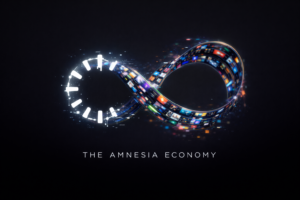

When “Brain Rot” was named the Oxford Word of the Year for 2024, it was easy to chuckle. The phrase sounds like a joke, Internet slang for the foggy, restless aftereffect of spending too much time online. But the humor masks a serious diagnostic reality. The term doesn’t just describe a bad habit; it captures the precise psychological residue of a media ecosystem engineered to dissolve memory.
I recently tried to recall the last Reel I watched. Then the one before it. I couldn’t. What I remembered was the sensation of them playing, one after another, a frictionless cascade of light and sound that required nothing of me. This amnesia isn’t a failure of my concentration. It is the successful result of a design philosophy that views “stopping” as a failure.
Short-form video, including Instagram Reels, YouTube Shorts, and TikTok, has become the dominant language of the internet. We often dismiss this content as “shallow,” but that critique misses the point. The problem isn’t that the videos are short; it’s that they have bulldozed the landmarks our brains rely on to understand time.
Long-form work, whether a video essay, a book, or a magazine feature, provides structural geography. There is an arc. A beginning asks you to lean in; an ending lets you come up for air. These structures do more than organize information; they help the brain encode duration. You feel time passing because you are moving through something.
Short-form platforms quietly obliterate this sense of movement. There is no arrival point and no natural conclusion. Each clip is self-contained, emotionally compressed, and immediately annihilated by the next. Without the friction of a beginning or an end, the brain struggles to create a memory. You remember that you watched, but not what you watched.
This explains the specific distortion of the “doomscroll.” While you are in the feed, the experience feels light, just one more clip, just a few seconds. But when you finally stop, the realization lands with physical weight: forty minutes have vanished, and you have nothing concrete to show for it. The content was designed to leave no residue.
To keep you in this state, creators have adapted to an environment where attention is measured in milliseconds. Spend enough time on these platforms, and the desperate patterns of survival become obvious. Fast cuts. Jump zooms. Urgent text overlays. Faces rushing the camera in the opening frame. These aren’t artistic choices; they are evolutionary adaptations to an algorithm that punishes hesitation.
The result is a loop that bypasses judgment. Sudden motion triggers alertness; abrupt audio jolts the nervous system. Your brain reacts before you have time to decide if the content is worth your time. By the moment you might object, the next video is already loading.
In this economy, “friction” is the enemy. But for the human mind, friction is essential. We need the resistance of a difficult paragraph, the pause of a scene change, or the silence after a film ends to process what we have consumed. Memorability requires space: space to pause, to reflect, to let ideas settle.
When we strip away that space in the name of engagement, we get a feed that feels deeply personal yet increasingly narrow, optimized to stimulate rather than satisfy. The “brain rot” we joke about is simply the feeling of a mind that has been fed but not nourished.
The solution is not to reject short-form media entirely; it can be funny, informative, and inspiring. The challenge for creators, technologists, and editors is to reintroduce friction. We need to design work that asks the viewer to stop, to think, and to remember, even if that means a few more people swipe past.
We are currently building an economy on the metric of forgetting, on the ability to wipe the mental slate clean instantly so the next ad can be served. In such a world, choosing to create work that sticks, work that offers landmarks rather than just flow, might be the most radical act of all.